Perigeo
2014
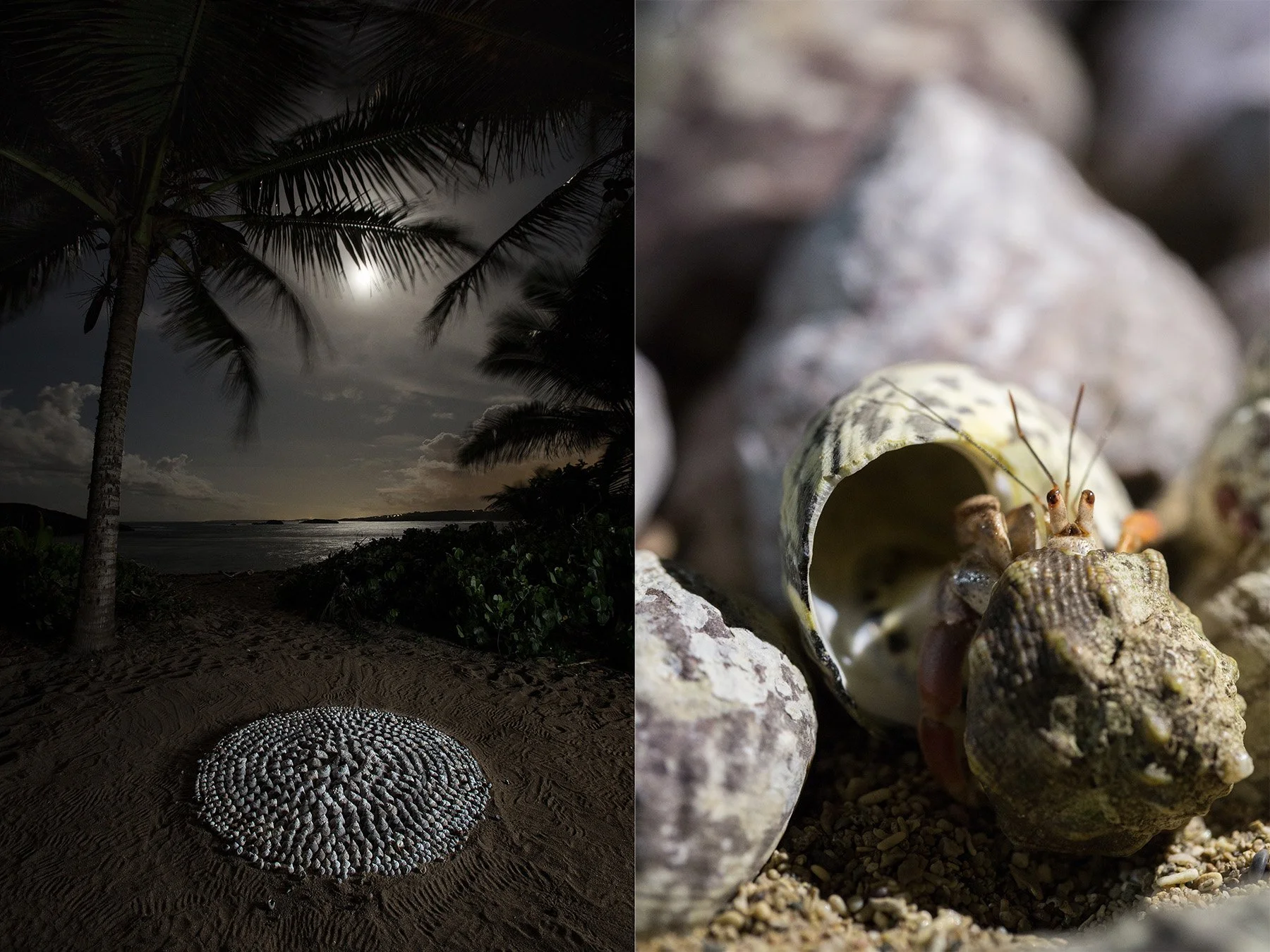
Late in the summer of 2014 we anticipated the massive migrating event of the hermit crabs in Puerto Rico called “La Cobada” with an offering mandala design of empty shells at Hacienda La Esperanza Nature Reserve in Manatí. This annual ritual of our shell offerings coincided with a clear night sky on September 9th, with the third consecutive and final super moon of that year. This votive act of giving back to nature, consists of returning empty magpie shells to their original natural setting, where they came from and where they serve an important ecological purpose for the health of our coastal environment. Reintroducing remnants shells from the fishing harvest of the “bulgao” is crucial because each one of them play a vital role in the population of the hermit crabs in the island. Vacant shells provide this vulnerable creatures with critical housing because they don’t grow their own shells. Their biology centers on shell availability relying entirely on finding those empty ones along the shoreline for protection and proper mating habits. The high level of extraction has adversely caused a dramatic reduction of the population among both species: the Cittarim Pica and the Coenobita Clypeatus. Through the recovery of these resources, we conceptually seek to reinstate the territory once removed to alleviate environmental pressure, though admittedly on a minuscule scale. Our mandala design not only mitigates extractive human behavior, but also reflect on the moon cycles of this anual biological event to bring awareness. Shells are first retrieved from dumpsters and areas far from the hermit crab habitat, then thoroughly cleaned and organized from smallest to largest. The design spirals out from the biggest one in the center to the smaller ones in the perimeter of the circle. This spiral design echoes the gradually expanding, rounded shape of the magpie shells used in the mandala, as well as the anatomy of the creatures that inhabit them. Ultimately, it serves as a symbolic image that alludes to the evolutionary growth of life as a universal cycle of natural adaptability.
Pre-Columbian cultures used these shells for instruments, crafts, and religious rituals. Today, people still collect them for decoration, but in the miniature world of a hermit crab, an empty shell is a critical matter of life and death. As the hermit crab grows in size, he seeks for larger shell to abandon its previous one, forming vacancy chains of second handed shells. However, the diminishing source of their availability has interfered with their natural behavior. Coastal development, pollution, and the commercial extraction of marine shells pose a critical threat to the survival of this native Caribbean animal. As their natural habitats and resources vanish, they are forced to shelter in the trash scattered across beaches. Plastic caps, bullet shells, bones, and even crack pipes or used needles are just some of the makeshift houses we have seen them inhabit out of desperation. However, none can thrive, let alone survive, for much longer inside these trashed and artificial objects. Therefore, our creative contribution aims to help restore ecological balance through a waste-exchange initiative. By providing empty shells from the fishing harvest, we allowed hermit crabs to swap the artificial trash they were using for a proper, natural home.
The hermit crabs interacted with the mandala immediately and continuously for nearly three weeks. "This biological process proves how urgently this matter needs to be addressed through integrated, creative actions with the natural medium. As the spiral slowly dissipated, restoring the site to its original state, a vast expanse of the landscape felt nourished, transforming the scenario into a healthier habitat. Among the leftover shells, a compilation of littered objects appeared, prompting a collaborative beach clean-up with the hermit crabs that keep this fragile coastal ecosystem alive. The abandoned trash redeems us, remaining in our personal collection of found objects as an emotional souvenir of awareness and a requiem of our appreciation for a cleaner environment