Laguna de Cornelio
2014
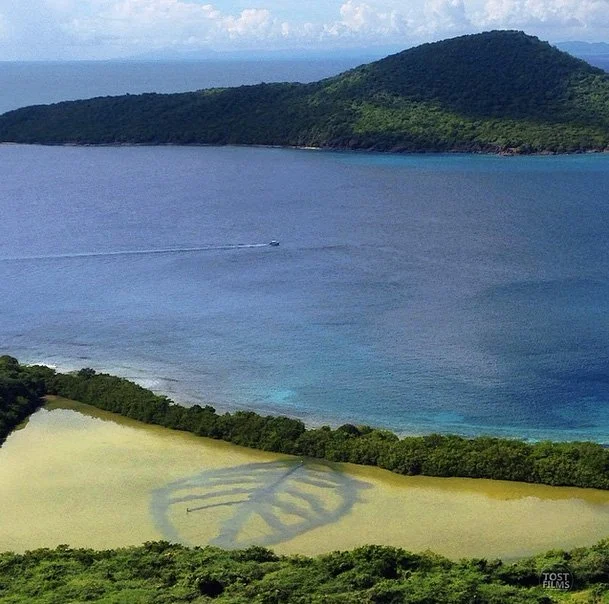
In December 2014, we came up with the idea of creating a colossal drawing in the Laguna de Cornelio, located on the west coast of Culebra Island, Puerto Rico. We envisioned this ephemeral intervention as an immense landscape watercolor, its fleeting presence dissipating with the minimal impact of our footsteps. To preserve the fleeting image, we coordinated the documentation process in collaboration with Mario Ramírez Capella (TostFilm), positioning fixed cameras at the summit of the nearest mountain. This allowed us to record its creation and eventual fading into an aerial time-lapse, captured from a high-angle perspective over the lagoon.
Due to the drought gripping the island during that season, only five inches of crystal-clear water remained over the thick muck settled at the bottom. Atop that soft layer of dark sediment, a thin coat of green silt covered the floor. Each step we took across the muck broke through this delicate film, stirring up the dark sediment hidden beneath the still, undisturbed green bed. Our paths left behind a black trail of sediment that eventually settled back down, but not before shaping forms beneath the water’s surface that shifted the very instant they formed. We walked in sync to create fractal designs reminiscent of the site's own vegetation. It was a schematic depiction of the organic landscape, where fallen, decaying foliage became the very medium we used to draw these images into existence.
Upon completing the drawing, we climbed to the summit of the mountain where we had positioned the cameras, only to watch it fade away with the setting sun. Little by little, the marked lines widened and blended into the water, just as fresh watercolor would on wet paper. The dark color of the thick sludge gradually dissipated as the sediment settled, yet a broken trail still remained where we had walked. Whenever the sky cleared, sunlight managed to pierce the water's surface without reflecting off the lagoon, making it possible to clearly see that trail of our footprints tracing the image on the bottom. Those footsteps might have lasted for about a month in the water, but eventually, they were reabsorbed into the green silt of the bed, as if no one had ever walked through the Cornelio Lagoon ever before.