XLIII
2015
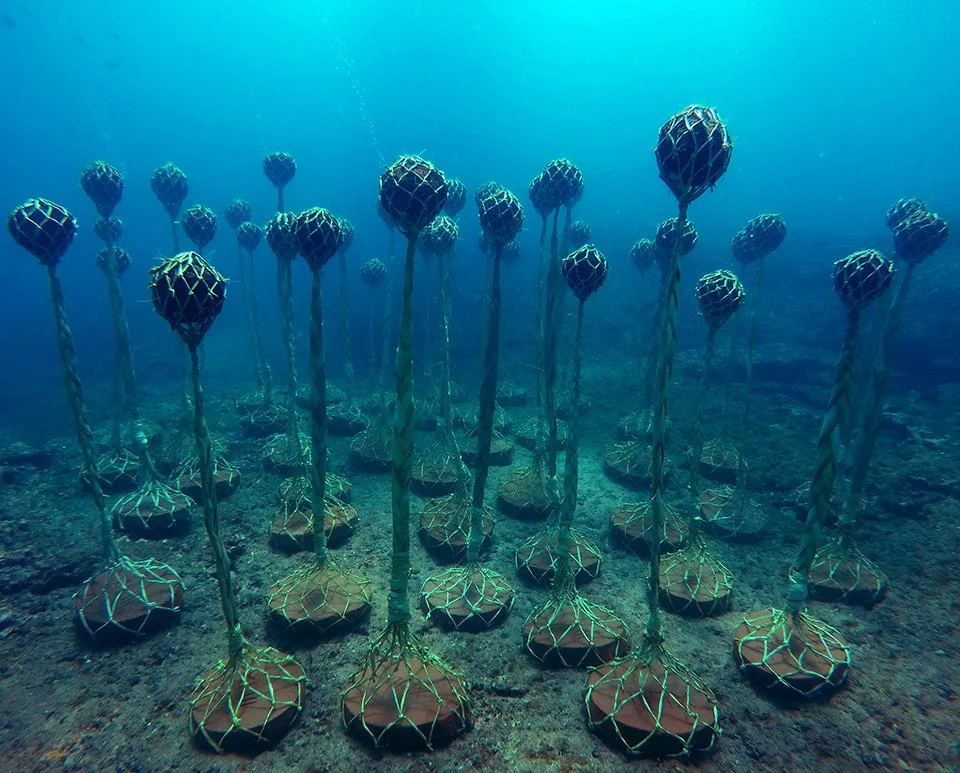
This underwater installation consists of 43 sculptures crafted entirely from organic materials gathered from the local landscape that inspired the project. Designed to decay naturally over time, the pieces leave absolutely no waste in the sea. The project was developed in close collaboration with two neighboring, coastal Afro-Mexican communities of fishermen and artisans from La Costa Chica of Oaxaca: El Venado and Aguazarca.
These two villages share a profound, symbiotic reliance on one another's resources. El Venado works extensively with palm trees, utilizing everything from harvested coconuts to wood and fronds for construction and artisanal crafts. Aguazarca specializes in terracotta bricks and roof tiles. Their traditional industries are deeply intertwined; Aguazarca requires massive amounts of coconut husks to fire their terracotta kilns, which El Venado supplies from the leftovers of their coconut oil, water, and flesh production. This husk fuel not only fires the kilns but also imparts a rich, reddish hue to the finished terracotta. In turn, El Venado uses Aguazarca’s bricks and tiles to build their homes and ovens. Inspired by this beautiful daily collaboration, we invited both communities into a creative engagement that challenged them to reimagine their crafts for a shared artistic purpose. This effort was anchored by two vital community leaders: Nemorio Díaz González from El Venado and Felipe de Jesús Cruz González from Aguazarca.
At the time, Mexico was collectively mourning the tragic disappearance of 43 young students, many of whom were from neighboring regions. The number 43 was deeply embedded in the national consciousness. This outrage was visible on every news broadcast, painted across street graffiti, and in daily conversations. Moved by this communal grief, we collectively decided to dedicate the 43 underwater sculptures to the memory of these students. Production began on the first year anniversary of the disappearance, culminating in an underwater Day of the Dead installation. Domestic altars known as “ofrendas” are common home displays in traditional Mexican celebrations honoring and welcoming the spirits of deceased loved ones.
To build the sculptures, we wove together the defining elements of both communities: empty coconut shells served as buoys to provide flotation (representing El Venado), woven fronds formed the structural bodies, and circular terracotta bricks acted as weights to anchor them to the seabed (representing Aguazarca). Each of the 43 sculptures were inscribed with the Roman numeral XLIII.
On the day of the installation, our main collaborators joined us on a fishing boat to transport the sculptures to Carrizalillo Beach. Free-diving to a depth of roughly 15 meters, we spaced the sculptures together carefully along the ocean floor to prevent tangles. Sealed with air, the coconut buoys held the structures upright. Once fully installed, the 43 sculptures appeared to engage in a synchronized, oscillating dance, swaying gently with the movement of the ocean waves. Photographs and film document the entire journey, tracking the project from early community integration and design phases to the crafting process and the final underwater ceremony. Each frame captures a poignant dance of culture where communal craftsmanship, collective remembrance, and an artisanal fishing identity converge in a sustainable act of creative honoring.